New Smyrna Beach Oceanfront Condo SIRS Deadlines Explained
August 13, 2026
August 13, 2026
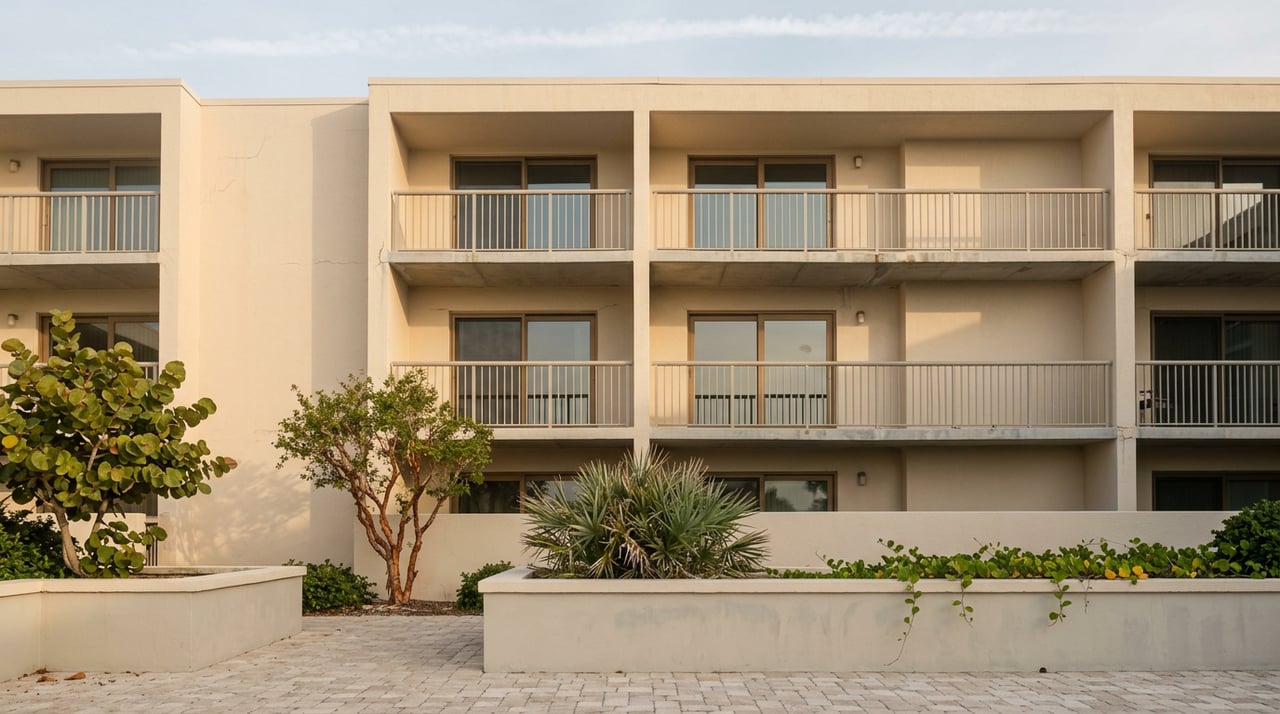
Walk Flagler Avenue toward the sand this month and the oceanfront towers look the same as they have for years: Ocean Walk's stacked balconies, Minorca's mid-rise silhouette, the older beachside buildings that have anchored this stretch since the 1970s and 80s. What you cannot see from the street is that most of these associations are running the same paperwork right now, on the same clock, and the outcome of that paperwork will decide what living in these buildings actually costs long after closing.
The number that matters here is not on any listing sheet. It is the reserve funding schedule a state-mandated engineering study assigns to a building, and as of this August, with less than five months left before the state's next hard deadline, that schedule is becoming impossible to ignore.
Florida's Structural Integrity Reserve Study, or SIRS, requires condo and co-op associations with buildings three or more habitable stories to fund reserves for eight structural components: roof, load-bearing structure, fire protection, plumbing, electrical, waterproofing, windows and doors, and any other item over the statutory threshold affecting those systems. Most owner-controlled associations that existed before July 1, 2022 had to complete their first SIRS by December 31, 2025, according to the Florida Department of Business and Professional Regulation, which oversees compliance through its Division of Condominiums.
Here is where the listing sheet stops telling the whole story. For any association budget adopted on or after January 1, 2025, the board cannot vote to waive or underfund the reserves a completed SIRS calls for. Older buildings that once kept dues artificially low by deferring these reserves no longer have that option. A unit that carried a modest monthly HOA fee last year can carry a materially different fee once its association's SIRS is finalized and its funding schedule kicks in on January 1, 2026, exactly the position many New Smyrna Beach buildings are in this year.
That is the mechanism buyers on the portals never see: two condos of similar size and vintage, a few doors apart, can be on completely different cost trajectories depending on where each building's association stands in this process.
The related requirement, the milestone structural inspection under Florida Statute 553.899, runs on its own timeline and it is not identical for every building. The statewide baseline triggers an inspection when a building turns 30 years old, then every 10 years after. But local building officials have latitude to require it earlier, as early as 25 years, for buildings closer to the coast. Broward County, for example, applies a 25-year trigger to every qualifying building countywide regardless of exact distance from the water, a policy choice that shows how much this timeline can vary by jurisdiction rather than by statute alone.
That local discretion is precisely why a buyer or seller on the barrier island in New Smyrna Beach should not assume a building's age alone tells them where it sits on the inspection clock. The only reliable answer comes from the association's own notice from Volusia County's local enforcement agency, or from the milestone report itself if one has already been issued.
"What this does is make people aware of how much it really costs to live in a condo near or on the beach."
That line came from Sheila McCollum of New Smyrna Beach Association Management, speaking not long after the state law first passed. It has only become more accurate as buildings along this coastline reach their inspection age in real time.
The two requirements get confused constantly, but they answer different questions and a buyer needs both answers before closing.
| Milestone Inspection | SIRS | |
|---|---|---|
| Governing statute | Fla. Stat. § 553.899 | Fla. Stat. § 718.112(2)(g) |
| What it answers | Is the building structurally sound today? | Is the association saving enough to pay for future repairs? |
| Trigger | 30 years old statewide (as early as 25 near the coast, at local discretion) | Every 10 years after the condominium's creation, for buildings 3+ stories |
| Who performs it | Licensed engineer or architect | Licensed engineer, architect, or certified reserve specialist |
| What happens if it's missed | Fines that can exceed $500 a day, code referrals, potential vacate orders | Association cannot legally waive required reserve funding |
Buildings due for both by the end of this year are allowed to coordinate them into a single engineering engagement, but under no circumstances can the SIRS be completed after December 31, 2026, per DBPR's own compliance guidance.
New Smyrna Beach's oceanfront stock is disproportionately exposed to this timeline because so much of it was built in the same window. The Ocean Walk at New Smyrna Beach complex alone spans multiple separately governed buildings, numbered individually rather than treated as one association, each running its own inspection and reserve schedule on its own calendar. Minorca Condominiums, another established oceanfront address here, faces the identical structural math simply by virtue of its age and its distance from the water.
The pattern is not new to this coastline. Florida's requirements trace back to the June 24, 2021 collapse of Champlain Towers South in Surfside, which killed 98 people and prompted the legislature to act the following year. Not long after that law passed, one anonymous New Smyrna Beach owner described renovating her unit two decades earlier at a cost of $50,000 to her personally, and said she could not absorb another assessment of that size if the new inspection cycle required it. Statewide at that time, more than 912,000 condo units were already past the 30-year mark, meaning the wave hitting New Smyrna Beach now was predictable years in advance.
Florida law gives a prospective condo buyer the right to specific documents at the seller's expense once a contract is signed, under Fla. Stat. § 718.503(2)(a). For a building of any age along this coastline, the ones worth actually reading before you write an offer are:
The estoppel or resale certificate that packages much of this together is capped by statute at $299, so there is no reason to accept a vague verbal summary from a listing agent in place of the actual paperwork.
For sellers, a completed and funded SIRS is becoming a genuine selling point rather than a formality. A building that has already absorbed its assessment and stabilized its reserves is a cleaner story for a buyer's lender and a buyer's peace of mind than one still waiting on engineering results. For buyers, the smart move is asking for milestone and SIRS status before falling for a view or a renovated kitchen, because the association's paperwork will shape your carrying cost far more than either of those.
Five months from today, the December 31 deadline closes for any association still coordinating a milestone inspection with its first SIRS. Buildings that have not started that process by now are unlikely to finish comfortably, and that timing pressure is already visible in how boards along this stretch are communicating with owners.
Does this apply to single-family homes in New Smyrna Beach? No. Both the milestone inspection and SIRS requirements apply only to condominium and cooperative buildings three or more habitable stories in height. Single-family homes, duplexes, and triplexes are not covered.
What if the building I'm considering hasn't completed a SIRS yet? The seller must disclose that in writing under state law rather than leave it unaddressed. Ask specifically whether the association has a completion date scheduled and whether any budget increase or assessment is anticipated once it's finished.
Are milestone inspections and SIRS the same document? No. A milestone inspection is a structural safety check performed by an engineer or architect. A SIRS is a financial planning document that determines how much the association must reserve for future repairs. A recent milestone inspection can sometimes substitute for the visual portion of a SIRS, but the two serve different legal purposes and a building can pass one while still lacking the other.
If you are weighing an oceanfront purchase or preparing to list a beachside condo in New Smyrna Beach before this deadline closes, the paperwork behind the listing matters as much as the view. Going Luxury Group works through exactly this kind of documentation with clients on both sides of the transaction. Contact Us to talk through what a specific building's status means for your timeline.
Stay up to date on the latest real estate trends.

We pride ourselves in providing personalized solutions that bring our clients closer to their dream properties and enhance their long-term wealth. Contact us today!